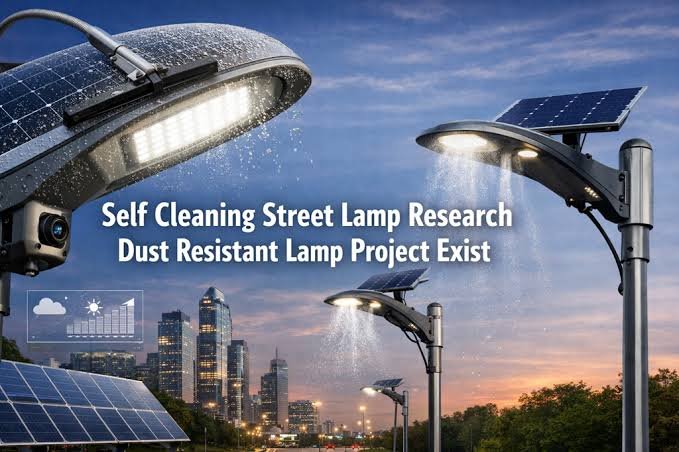
Self-cleaning street lamps are no longer just a futuristic idea. As cities grow and environmental challenges increase, researchers and engineers are actively exploring smarter lighting systems that can resist dust, clean themselves, and maintain consistent brightness without constant human intervention. In regions where pollution, sandstorms, or industrial dust are common, traditional street lighting quickly loses efficiency. Dust accumulation on lamp covers and solar panels reduces light output, increases maintenance costs, and affects public safety. This is where self-cleaning and dust-resistant lamp projects come into focus.
Recent research into self-cleaning street lamps and dust-resistant lighting systems shows that real-world prototypes and pilot installations already exist. Universities, smart city developers, and lighting manufacturers are testing advanced coatings, automated cleaning mechanisms, and sensor-based monitoring to reduce maintenance and improve durability. This article explores how these systems work, what technologies power them, whether such projects truly exist, and what the future holds for dust-resistant street lighting solutions.
Understanding the Concept of Self-Cleaning Street Lamps
Self-cleaning street lamps are outdoor lighting systems designed to automatically remove or resist dust, dirt, and environmental debris. Unlike traditional street lights that require periodic manual cleaning, these systems use built-in technologies to maintain clear surfaces and consistent illumination. The core goal is to ensure that lighting performance does not decline due to environmental exposure.
Dust and pollutants can significantly reduce light transmission when they settle on lamp lenses or solar panels. In solar-powered street lights, even a thin layer of dust can lower energy conversion efficiency. Over time, this leads to dimmer streets, higher energy costs, and frequent maintenance visits. Self-cleaning systems aim to solve this by either preventing dust from sticking or actively removing it through automated processes.
Why Dust Resistance Matters in Modern Street Lighting
Dust resistance is particularly important in urban areas with high air pollution, construction activity, or desert climates. In such environments, street lights can become covered in particles within weeks. This buildup not only affects brightness but can also trap moisture and accelerate wear and corrosion of components.
Municipalities often spend significant budgets on cleaning and maintenance crews to keep street lighting functional. In large cities, this becomes a recurring operational cost. Dust-resistant lamp projects are being researched to lower these long-term expenses. By improving surface materials and adding automated cleaning functions, cities can extend the lifespan of lighting infrastructure while maintaining road safety and visibility.
Core Technologies Behind Dust-Resistant Lamp Projects
The foundation of self-cleaning street lamp research lies in advanced material science. Many prototypes use hydrophobic and oleophobic coatings that reduce the surface energy of lamp covers. This makes it harder for dust, water, and grime to stick. When rain falls or wind blows, particles are more easily washed or blown away.
In addition to passive coatings, active cleaning mechanisms are being developed. Some designs include small rotating brushes or wipers that sweep across solar panels or transparent covers at scheduled intervals. Others use vibration systems that shake off loose particles. There is also research into electrostatic dust repulsion, where electrically charged surfaces prevent fine particles from settling in the first place.
Role of Smart Sensors and IoT Integration
Modern self-cleaning street lamps are often integrated with smart city technology. Sensors can monitor light output, detect performance drops, and trigger cleaning cycles automatically. If illumination falls below a certain threshold due to dust buildup, the system can activate its cleaning mechanism without waiting for manual inspection.
IoT connectivity allows remote monitoring of street light performance. City management systems can track cleaning cycles, energy consumption, and operational health in real time. This integration transforms street lighting into an intelligent infrastructure network rather than a simple light source. It also supports predictive maintenance strategies, where potential issues are addressed before failure occurs.
Existing Research and Real-World Projects
Research into dust-resistant and self-cleaning street lamps is ongoing across multiple countries. Universities have published studies on nano-coatings that repel dirt and on automated robotic cleaning systems for solar panels. These innovations are directly applicable to solar street lighting, which is especially vulnerable to dust accumulation.
Some manufacturers have introduced solar street lights equipped with automatic cleaning modules. In certain pilot projects, small robotic arms or linear brush systems clean solar panels on a schedule. These systems are particularly useful in desert highways, remote industrial zones, and areas with frequent dust storms. While not yet universal, these projects confirm that the concept is practical and already implemented in specific contexts.
Benefits of Self-Cleaning and Dust-Resistant Street Lights
One major benefit of self-cleaning street lamps is reduced maintenance cost. Traditional street lights require periodic cleaning using manual labor or specialized equipment. Automated systems lower the frequency of these interventions, saving time and resources for municipalities.
Another key advantage is consistent lighting performance. When lenses and panels remain clean, illumination levels stay stable. This improves road safety, pedestrian visibility, and overall urban security. Additionally, cleaner solar panels produce more energy, increasing system efficiency and supporting sustainability goals in smart city development.
Challenges in Implementation and Adoption
Despite promising advancements, there are challenges in scaling self-cleaning street lamp projects. One issue is the higher upfront cost compared to conventional lighting systems. Advanced coatings, embedded motors, and sensor integration increase manufacturing complexity.
Durability is another concern. Mechanical cleaning parts must withstand harsh outdoor conditions, including temperature fluctuations and abrasive dust. If poorly designed, these systems could require repairs that offset maintenance savings. Ongoing research focuses on improving reliability while reducing production costs to encourage wider adoption.
Environmental and Sustainability Impact
Self-cleaning street lamps contribute to environmental sustainability in several ways. By maintaining optimal light output, they reduce the need for overpowered lighting to compensate for dirt buildup. This supports energy efficiency and reduces electricity consumption.
In solar-powered models, dust-resistant features enhance renewable energy performance. Clean solar panels generate more electricity and reduce reliance on grid power. Over time, this helps cities lower their carbon footprint while improving resilience in remote or off-grid locations.
Future of Dust-Resistant Lamp Research
The future of self-cleaning street lamp technology is closely tied to advancements in nanotechnology and smart materials. Researchers are exploring ultra-thin coatings inspired by natural surfaces, such as lotus leaves, which naturally repel water and dirt. These biomimetic designs could significantly improve dust resistance without moving parts.
Artificial intelligence and data analytics may also enhance cleaning efficiency. Systems could analyze weather patterns and pollution data to adjust cleaning frequency automatically. As smart city infrastructure expands, self-cleaning lighting may become a standard feature rather than a specialized innovation.
Read More ; Abraham Quiros Villalba: Renewable Energy Leader, Investor & Journalist
Conclusion and Final Thoughts
Self-cleaning street lamp research and dust-resistant lamp projects do exist, and they are steadily moving from experimental stages into real-world applications. Through advanced coatings, automated cleaning mechanisms, smart sensors, and IoT integration, these systems aim to solve one of the most persistent problems in outdoor lighting: dust accumulation and performance decline.
While challenges remain in terms of cost and durability, the long-term benefits of reduced maintenance, improved safety, and enhanced energy efficiency make this technology highly promising. As cities continue to invest in smart infrastructure and sustainable solutions, self-cleaning and dust-resistant street lamps are likely to play an increasingly important role in shaping the future of urban lighting.